
Jung’s Transcendent FunctionThe Underlying Rule to All Psychic Transformation
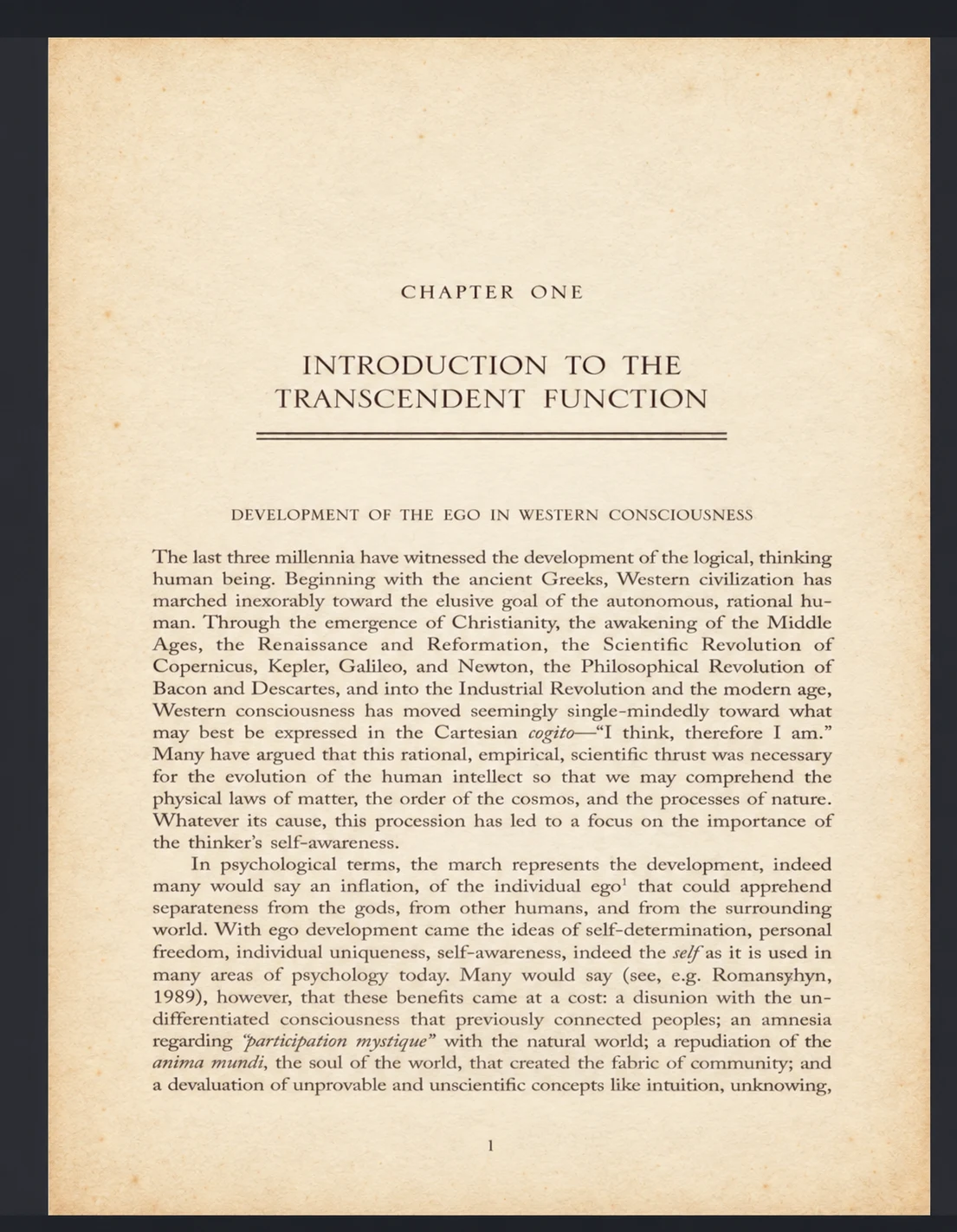
The transcendent function is Jung’s term for a psychological process in which conscious and unconscious material come into relationship, making a new attitude possible. It describes how an inner conflict can become an opportunity for development when something previously excluded is given a place in conscious life.1
Imagine feeling caught between being dependable and wanting freedom. Every decision seems to demand that one part of you defeat the other.
What does “transcendent” mean here?
In this context, transcendent refers to a transition beyond an existing psychological attitude. Jung’s formulation concerns a change that preserves contact with unconscious material instead of simply suppressing it. In his essay “The Transcendent Function,” Jung explains the term:
“It is called ‘transcendent’ because it makes the transition from one attitude to another organically possible, without loss of the unconscious.”
Here, an attitude means a person’s overall psychological orientation. The change emerges through engagement with unconscious material, allowing something previously excluded to contribute to a new outlook.
A useful reading question is therefore: What could change in the way this person understands the problem? Finding another option may matter, but a new option and a new attitude are not necessarily the same achievement.
An example: dependability and freedom
Consider Maya, who is known among her friends as the person who always helps. She organizes trips, answers late calls, and changes her plans whenever someone needs her. She values these relationships and takes pride in being reliable.
Recently, however, she has begun to resent the very requests she usually welcomes. She imagines leaving everyone behind. Then she feels guilty and volunteers for another task. The pattern becomes predictable: overcommitment, resentment, escape fantasies, guilt, and renewed overcommitment.
At first, Maya describes her choice as “be generous or be selfish.” That description already favors one side. Anything associated with her own wishes has been placed in the category of moral failure.
Suppose that, in this example, Maya dreams of a house whose front door has been removed. People can enter whenever they like. She initially treats the dream as another accusation: perhaps she should be even more welcoming. Later she notices a different possibility. A house can have a door and still receive guests.
The dream gives her something to consider. She starts asking whether friendship requires permanent availability, and whether saying no sometimes might allow her yes to mean more.
A practical change follows. She offers help when she can, names what she cannot do, and allows other people to participate. She still cares about her friends. She also begins to experience her own needs as part of a relationship rather than a threat to it.
- Initial position: Being dependable means always being available.
- Conflicting experience: Resentment and fantasies of escape become difficult to ignore.
- Dream worth exploring: A welcoming house can still have a door.
- Emerging attitude: Care can include both generosity and boundaries.
- Everyday consequence: Maya can offer help without promising unlimited access to herself.
Holding the tension of opposites
Emilija Kiehl, a Jungian analyst and teacher based in London, explores this process in an introductory essay for the International Association for Analytical Psychology (IAAP), an international professional organization for Jungian analysts. She emphasizes the creative possibilities within the tension between conscious and unconscious positions. A symbol can provide a meeting point through which a new attitude develops.1
In Maya’s example, merely repeating “I am generous” would leave her resentment unexplored. Abandoning every friendship would replace one extreme with another. A negotiated reduction in her commitments might be sensible, but the deeper shift concerns what she believes friendship permits.
That distinction helps explain why the transcendent function cannot be identified just by looking at an outcome. Two people could make the same practical decision for very different reasons. The account concerns the psychological relationship through which a decision becomes possible.
Thanks for reading Jungstein.
Subscribe for free to receive new essays on Jung and the psyche.
How active imagination relates to the transcendent function
Active imagination is a practice Jung developed for consciously engaging with the contents of the unconscious. A person might begin with a dream image, a persistent feeling, or a spontaneous inner scene, giving it sustained attention and allowing it to develop without deciding everything that happens.
The person then participates: asking questions, responding to an imagined figure, or expressing what emerges through writing, drawing, or movement. This creates an opportunity for feelings and perspectives outside their usual conscious outlook to become recognizable and enter into dialogue with it.
In Maya’s example, the house without a door could become a starting point. Exploring that image might help her encounter both her wish to welcome others and her need for privacy, without immediately dismissing either.
Active imagination can therefore support the transcendent function by bringing conscious and unconscious positions into relationship. It names a way of engaging with unconscious material; the transcendent function describes the process through which that encounter may give rise to a new attitude. Transformation is a possibility, rather than an automatic result.
Chiara Tozzi, a Jungian analyst and psychotherapist based in Rome, explains this practice in an introductory essay published by the IAAP. She emphasizes both receptivity and participation: allowing an image to emerge while consciously engaging with it. For Tozzi, this encounter also carries an ethical responsibility to consider how its insights affect everyday life and relationships.3
An imagined conversation is also not automatically wise simply because it feels vivid. For this article’s example, the useful question is whether Maya can examine the dream, consider her actual circumstances, and take responsibility for what she does next. This is an explanation of Jungian ideas, not a guided active-imagination exercise.
How does it relate to Jung’s cognitive functions?
The transcendent function is closely related to the development of Jung’s psychological functions. Thinking, feeling, sensation, and intuition describe ways of perceiving and judging. Our conscious outlook gives some of these ways more room than others.
Engagement with unconscious contents can bring neglected perspectives into awareness. Someone who habitually relies on thinking, for example, may encounter feelings and values that their usual explanations cannot adequately accommodate. Development involves allowing those values to matter while continuing to think clearly about them.
Our proposal is that repeated, reflective engagement with unconscious contents can help develop the capacity to sustain tension between these perspectives. A person may become better able to acknowledge an unfamiliar response without immediately dismissing it or being overwhelmed by it. The transcendent function describes the possibility that this encounter changes the attitude from which they perceive and judge.
How does it relate to individuation?
Individuation is the broader developmental context. Jeffrey C. Miller’s study places the transcendent function at the center of Jung’s account of psychological growth and dialogue with the unconscious.4 It is more precise to discuss the transcendent function as a process involved in individuation than to use both terms as names for every experience of personal change.
In our example, Maya’s insight would be one development in a life that remains unfinished. She could still face other conflicts, revisit old habits, and discover that her new understanding needs adjustment. The example offers no final certificate of wholeness.
Is the transcendent function always positive?
Sustained tension does not guarantee integration. Sometimes a difficult experience becomes harder to acknowledge, articulate, or reflect on. The conflict may become less visible without being resolved.
Early childhood trauma can leave a child with feelings and protective responses they do not yet have the capacity to understand. Hiding distress, anticipating danger, or suppressing needs may help preserve an essential relationship. Those responses can continue after the circumstances that formed them have changed.
In the Jungian language used here, this can be understood as the “installation” of energy in the unconscious: fears, expectations, and protective reactions that influence experience without being clearly recognized.
Our proposed reverse movement is a loss of conscious relationship with those contents. The diagram illustrates that possibility: an experience becomes increasingly difficult to hold in awareness and moves beyond the reach of deliberate reflection.
Backrooms: inhabiting what has been excluded
Backrooms (2026), directed by Kane Parsons, is a psychological horror film in which a strange doorway appears in the basement of a furniture showroom. I read its movement from a familiar setting into an unfamiliar world as a depiction of the process described above, unfolding in reverse.
Where integration brings unconscious material into a relationship with consciousness, the backrooms can symbolize experiences that have become difficult to reach consciously. In this reading, what has been excluded becomes an environment we inhabit. We may find ourselves repeatedly encountering the same fears, expectations, and defensive responses without understanding what organizes them. The horror lies in being caught within something whose influence we experience but whose meaning remains inaccessible.
Backrooms (2026), directed by Kane Parsons. Official trailer, A24.
The question becomes: how do we develop a relationship with what this inner environment contains? In the model proposed here, that involves gradually becoming able to recognize difficult experience, remain present with its tension, and allow it to enter into dialogue with our conscious outlook.
Different methods, a shared possibility
The transcendent function may describe a process that extends beyond explicitly Jungian practice. Different therapeutic approaches may provide different conditions for bringing previously excluded experience into conscious relationship.
Where that encounter gives rise to a new attitude, I understand it as an expression of the transcendent function—even when the approach uses another vocabulary. This is the interpretive framework proposed in this article, rather than a demonstrated explanation of every treatment’s effects.
The capacity at stake is more than enduring distress. It is being able to acknowledge a difficult feeling or perspective while retaining enough conscious participation to question, respond, and reflect. In our model, that capacity can develop through repeated engagement, supported by circumstances and relationships that make the encounter manageable.
The possibility of change begins when what previously governed us without recognition becomes something we can enter into relationship with.
When did Jung write the essay?
Jung wrote “The Transcendent Function” in 1916. James Hillman’s preface identifies a privately printed English translation for students at the Jung Institute in Zurich in 1957. Miller’s book distinguishes that original text from the 1958 version.54
For further reading, start with Jung’s essay in Collected Works, volume 8. Miller’s The Transcendent Function: Jung’s Model of Psychological Growth through Dialogue with the Unconscious compares the original and later versions. Kiehl’s IAAP article offers a contemporary Jungian explanation.41
Thanks for reading Jungstein.
Subscribe for free to receive new essays on Jung and the psyche.