Systema Munditotius Explained:Carl Jung's First Mandala
What Is Systema Munditotius?
Systema Munditotius—also written Systema Mundi Totius—is the name Carl Jung gave to his first completed mandala. He began the image in 1916 while working through the material that became Liber Novus and the Seven Sermons to the Dead. The title is commonly rendered as “system of all worlds” or “system of the whole world.”12
The mandala presents a symbolic cosmos arranged around a center. Rings, paired figures, and opposing poles place unity and conflict inside the same field. It is not a personality-type chart, and Jung did not propose the interactive model presented on this site. The historical image is the source; the Jungstein Explorer is a contemporary interpretation inspired by its spatial treatment of opposition, relation, and center.
At a glance
- What is it? Carl Jung’s first completed mandala.
- When was it made? Jung produced the first sketch in 1916 and developed it into the painted Systema Munditotius.
- What does the name mean? Approximately “system of all worlds” or “system of the whole world.”
- What is it related to? The symbolic cosmology of Seven Sermons to the Dead.
- What does Jungstein add? A modern interactive spatial model for exploring axes, neighboring positions, and opposing pressures.
When Jung Created His First Mandala
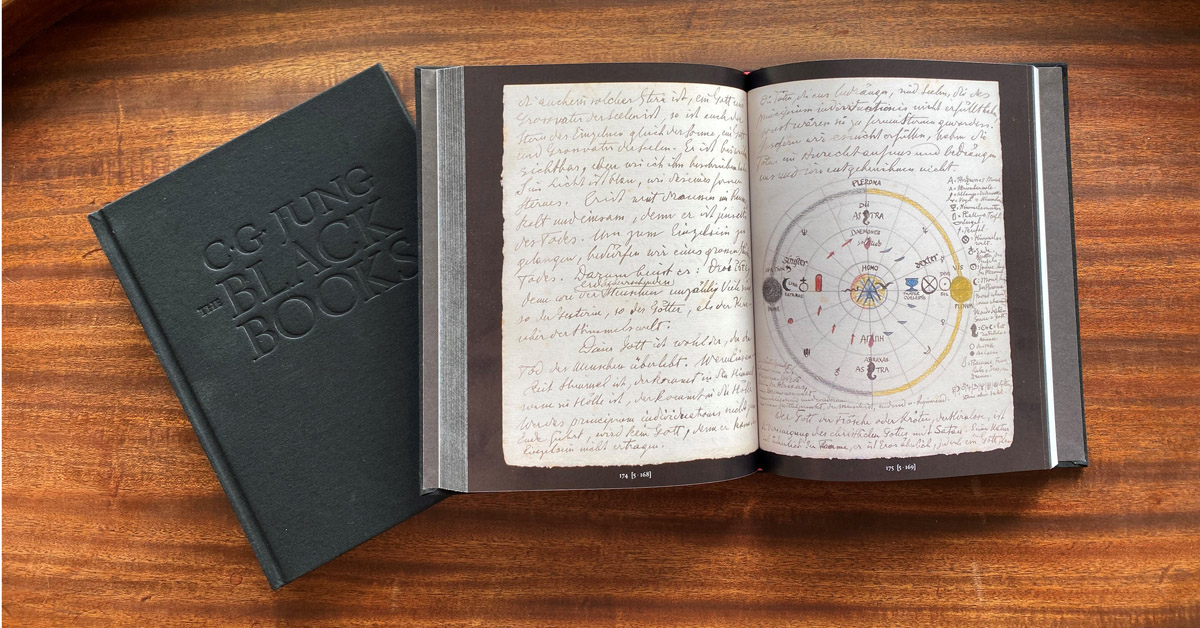
Jung drew the first known sketch on January 16, 1916, in the notebooks now published as the Black Books. He later described the finished work as the first mandala he had constructed and said that, at the time, he did not yet understand what it meant.1 The image belongs to the period of his confrontation with the unconscious, when private visions, active imagination, and symbolic experiments were taking the forms later collected in The Red Book.
Systema Munditotius and Seven Sermons to the Dead
The mandala and the Seven Sermons emerged from the same creative period and share a symbolic vocabulary. Sonu Shamdasani describes Systema Munditotius as a pictorial cosmology of the Sermones, while historical studies published by the Philemon Foundation examine the two works as closely related expressions of Jung’s developing cosmology.2 Reading them together helps explain why the mandala feels less like an isolated decoration and more like a map of a complete psychic world.
Reading the Mandala
Pleroma and the center
The outer field is identified with the Pleroma, the undifferentiated fullness from which distinct forms and opposites emerge. Toward the middle, the composition gathers its tensions around a central star. The center should not be treated as a simple label with one fixed translation; it acts as the organizing point through which the surrounding oppositions can be seen as parts of one totality.3
Phanes and Abraxas
The upper and lower regions are associated with Phanes and Abraxas. They belong to contrasting spiritual and material poles, but the image does not allow either side to stand alone. Each gains meaning through its position relative to the center and to its opposite.3
Paired opposites
The mandala repeatedly organizes differences as paired tensions: above and below, light and dark, spiritual and material, creation and dissolution. Its importance for this project lies in that relational structure. A pole is never merely an isolated thing; it is also a position inside a larger field.
What Jung Said About the Image
Jung’s later remarks emphasize that he initially created the mandala without consciously understanding it and only gradually recognized the significance of mandalas as expressions of psychic totality and orientation toward a center.14 That history argues for some restraint: the image is best approached as a symbolic construction that gathers relationships, not as a diagram with a single mechanical key.
The Story Behind the Explorer
The chart would not sit still. I kept drawing the same two axes, then redrawing them, then declaring the thing finished, then opening the file again because the same cluster kept coming back. There is a point at which a person should admit that a diagram has become an obsession. I got there late.
One version put thinking and feeling on a horizontal line and intuition and sensing on a vertical one.5 Another rotated it into a diamond. The same arrangement kept returning. Four positions gathered toward the middle. Others flanked them. The pattern suggested one shared field with crowded neighborhoods and long borders.
The question at first was embarrassingly simple: if these oppositions are real, why are they so rarely drawn as positions in relation to each other? Why did so much typology material online feel like a drawer full of labels instead of a map you could actually move through?
When Everything Starts Looking Like Pathology
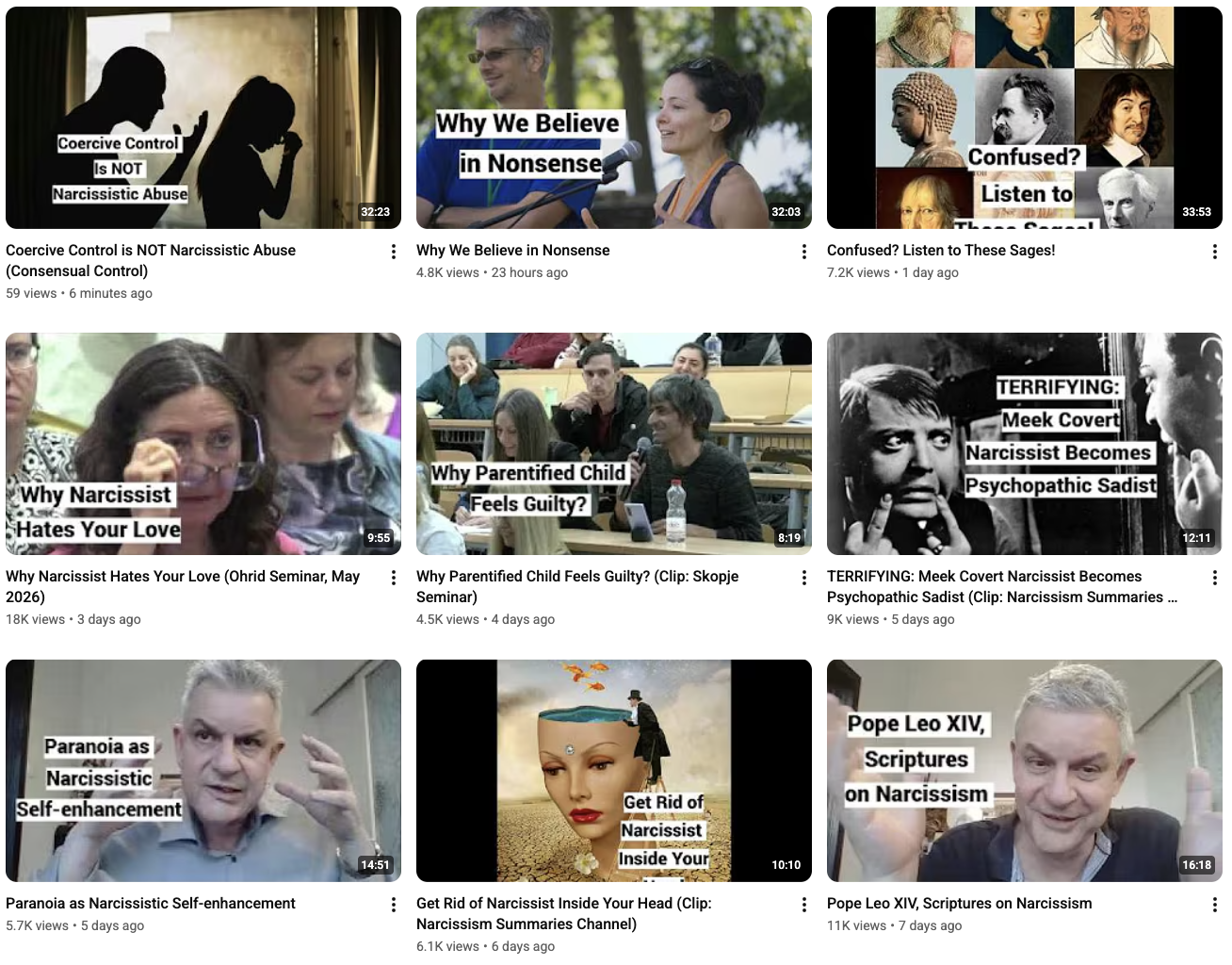
This did not begin in an especially serene season of life. It began in the middle of divorce, rebound relationships, therapy, and too many nights with YouTube open to another lecture about narcissists, cluster-B disorders, trauma patterns, and the little red flags that start multiplying once you have learned how to see them. The framework was often clarifying. It was also ruthless. After a while it could make a dinner party feel like a diagnostic intake form.
That way of seeing had force. It explained repetition, manipulation, overreaction, idealization, collapse. It also made the world smaller and meaner. Once every difficult trait starts arriving already tagged as pathology, you do get sharper at reading damage, but you get worse at reading psyche as a whole living thing.
A Wider Vocabulary
Jung entered the picture sideways, through online lectures, essays, scattered conversations, and a lot of reading. At first it was curiosity. Eventually it reorganized the categories. Archetype, shadow, possession, compensation, and integration did not make suffering any less real. They made the picture larger. The psyche looked like a system: conflict, over-identification, image, imbalance, and the slow work of bringing opposed pieces into relation.
That mattered because the newer vocabulary held more than blame. A person could be seized by a pattern, inflated by a pattern, defended by a pattern, split by a pattern, and still be understood as living inside something developmental rather than merely broken. That is a larger world to stand in.
The Typology Detour That Was Not A Detour
Then came the typology phase: Jungian forums, type-code communities, personality-disorder subreddits, cognitive-function diagrams, arguments with strangers, arguments with myself, and the genuinely alarming amount of time a person can spend asking whether one temperament is actually neighboring another. It was a ridiculous phase in one sense. It was also productive. The language made things tactile. You could test it against memory, attraction, conflict, fantasy, work habits, and the peculiar fact that one life can show up as several nearby types without feeling arbitrary.

The recurring cluster in my own case became hard to ignore: INTJ, ISTP, INFJ, INTP. I seemed to show up as each of them at different times, which is exactly the sort of thing MBTI communities tend to dislike. There is a strong dogma there: you do not switch types. But outside the doctrine, people keep saying otherwise. Friends, forum posts, and casual internet arguments are full of people describing how their type changed, softened, inverted, or revealed another face over time.
I have to admit, I land more on the side of travel than fixed residence. Jung’s language of individuation and spiritual alchemy makes the psyche look less like a passport office and more like a transformational field. If I could see myself moving through these four types, then perhaps they were not separate boxes at all. Perhaps they were neighboring territories.
Naturally, with the humility appropriate to such discoveries, I put myself in the center.
Early Cartesian Charting
The composite below comes from that stage. These were rough attempts. But the later structure is already there: a center point, opposing axes, adjacency, and the idea that nearby types may be neighboring states inside one structure.
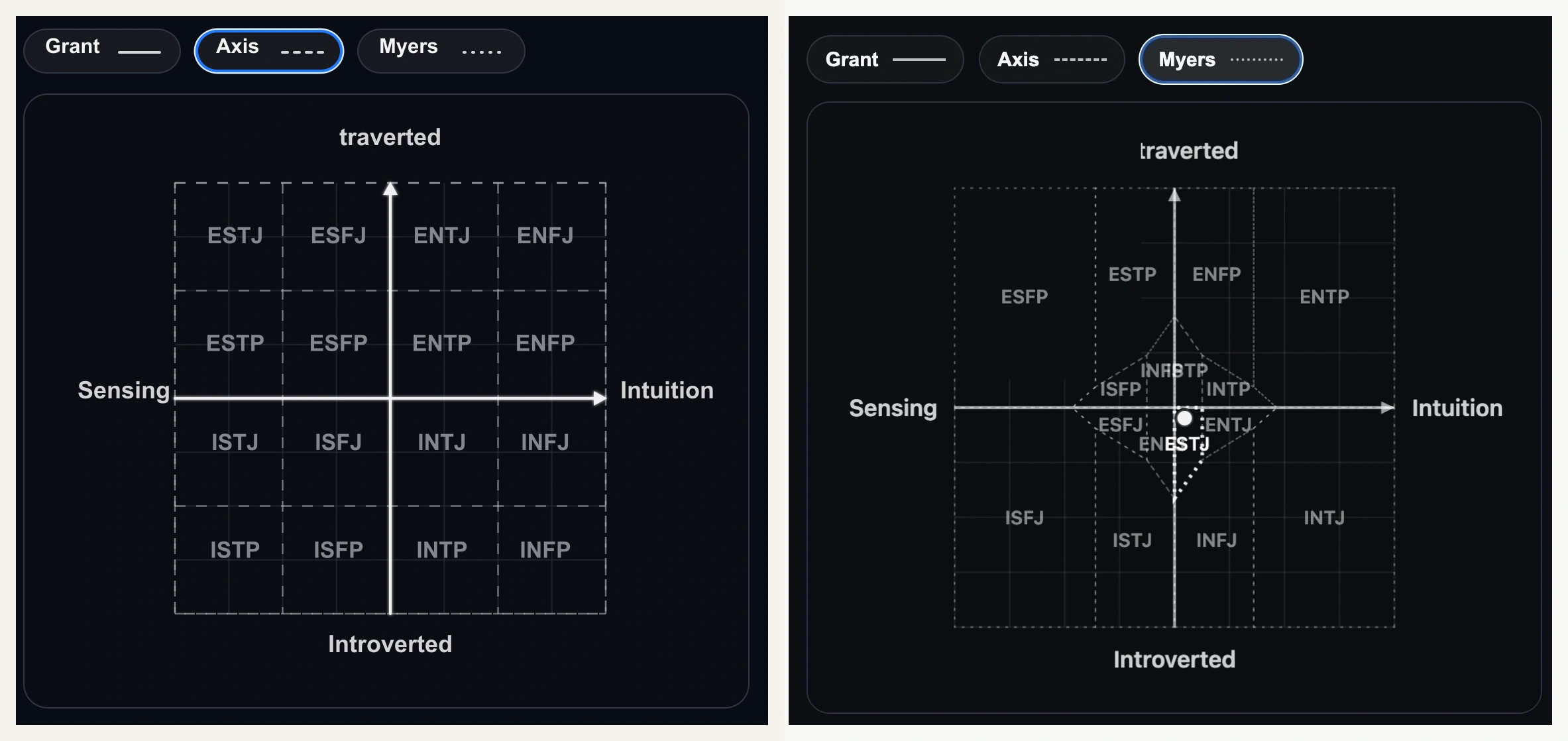
After enough repetitions, the geometry stops asking for your opinion. Four positions gather toward the middle. The central positions invite flanking positions. Four more settle toward the perimeter. After a while, the pattern feels documented. That was the useful turn. The chart posed a structural problem.
The Pattern Starts Locking In
The next point was simple. Position gains meaning through relation. A type has neighbors, tensions, compensation patterns, and nearby territories that pull on it. A position can look stable and still be under pressure from adjacent positions. It can lean one way in one context and reveal another contour in the next. The chart behaved like a field.
That is where the later explorer begins. The axes remain. The oppositions remain. The important variable is the space between positions. Distance matters as much as placement.
Then The Mandala Turns Up
Only after that did Jung's image arrive with its full force. On January 16, 1916, Jung sketched a mandala in the Black Books and later translated it into the painted image he called Systema Munditotius. He would later say that he drew the first mandala wholly unconscious of what it meant.1 In time the image would stand close to the symbolic world of Liber Novus and the Seven Sermons to the Dead2: center, ring, opposition, transformation, layered order, a whole world held around a middle.4
The important fact is that this image made it out of private record and into public document at all.6 The Black Books were the working notebooks of his confrontation with the unconscious, the source material from which much of the Red Book was drawn, and they were not published in full until 2020.7
There is a sharper human point here. Jung seems to have known that releasing material like this risked collapsing the public image of the clinician and theorist into the more private figure moving through visionary confrontation. So the image arrives belatedly, almost as a recovery. It could easily have remained sealed away from public culture.8
This is the first mandala I constructed in the year 1916, wholly unconscious of what it meant.
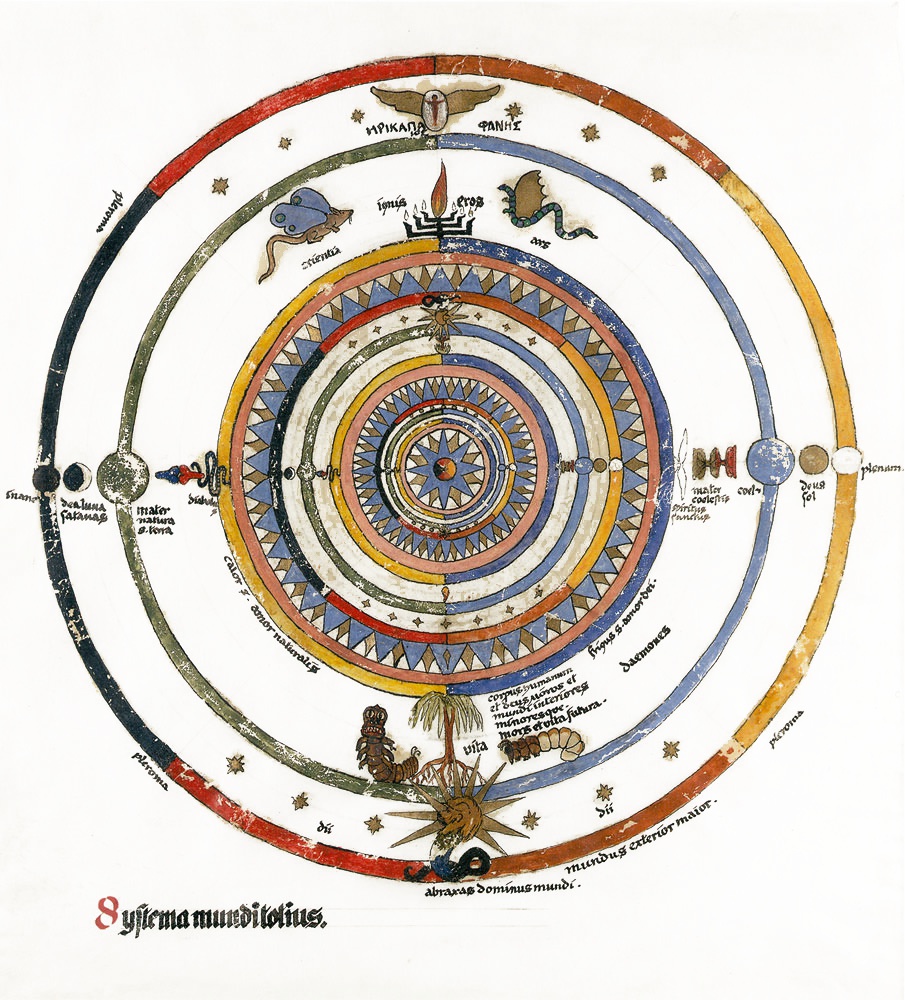
The important fact was structural overlap. The older image had already staged, symbolically and long in advance, a structural problem the newer chart kept backing into from another direction. Center. Opposed movement. Multiple rings. A world organized spatially. It was like finding an old blueprint for a machine I had been assembling from scrap without yet knowing its name.
Recognition
Jung had already supplied the title. Systema Munditotius translates roughly as “the system of all worlds,” or “the system of the whole world.”
I find that all my thoughts circle round God like the planets round the sun, and are irresistibly attracted by him.
That older symbolic image did not give me a ready-made model. It did something better. It clarified where the search had already been heading.
Historical Source vs. Jungstein Interpretation
The historical layer of this article concerns Jung’s 1916 mandala, its relationship to the Black Books, Liber Novus, and the Seven Sermons, and the symbolic figures documented in those sources. The citations below support that layer.
The Jungstein layer begins where the article turns to cognitive-function axes, neighboring type positions, projection fields, and relativistic geometry. Those ideas are original interpretive and experimental extensions. They are inspired by the way Systema Munditotius holds opposites around a center, but they should not be read as claims that Jung himself designed this type map or endorsed its mathematical model.
From Jung's Mandala to the Systema Explorer
The explorer below is the grown-up version of those stubborn sketches.
Open the interactive Systema Explorer, start the Cognitive Function Axes tour, or watch the Systema Munditotius map reveal.
How The Code Lands On The Map
I built the explorer around a simple question: what happens if the type codes are treated less like labels and more like positions?
Once the types were arranged in a particular geometric relationship to each other, other patterns started coming out of the woodwork. The neighbors began to look familiar. Certain types that seem separate in a list started sitting near each other for reasons that felt less arbitrary. The map began suggesting relationships before I had clean language for them.
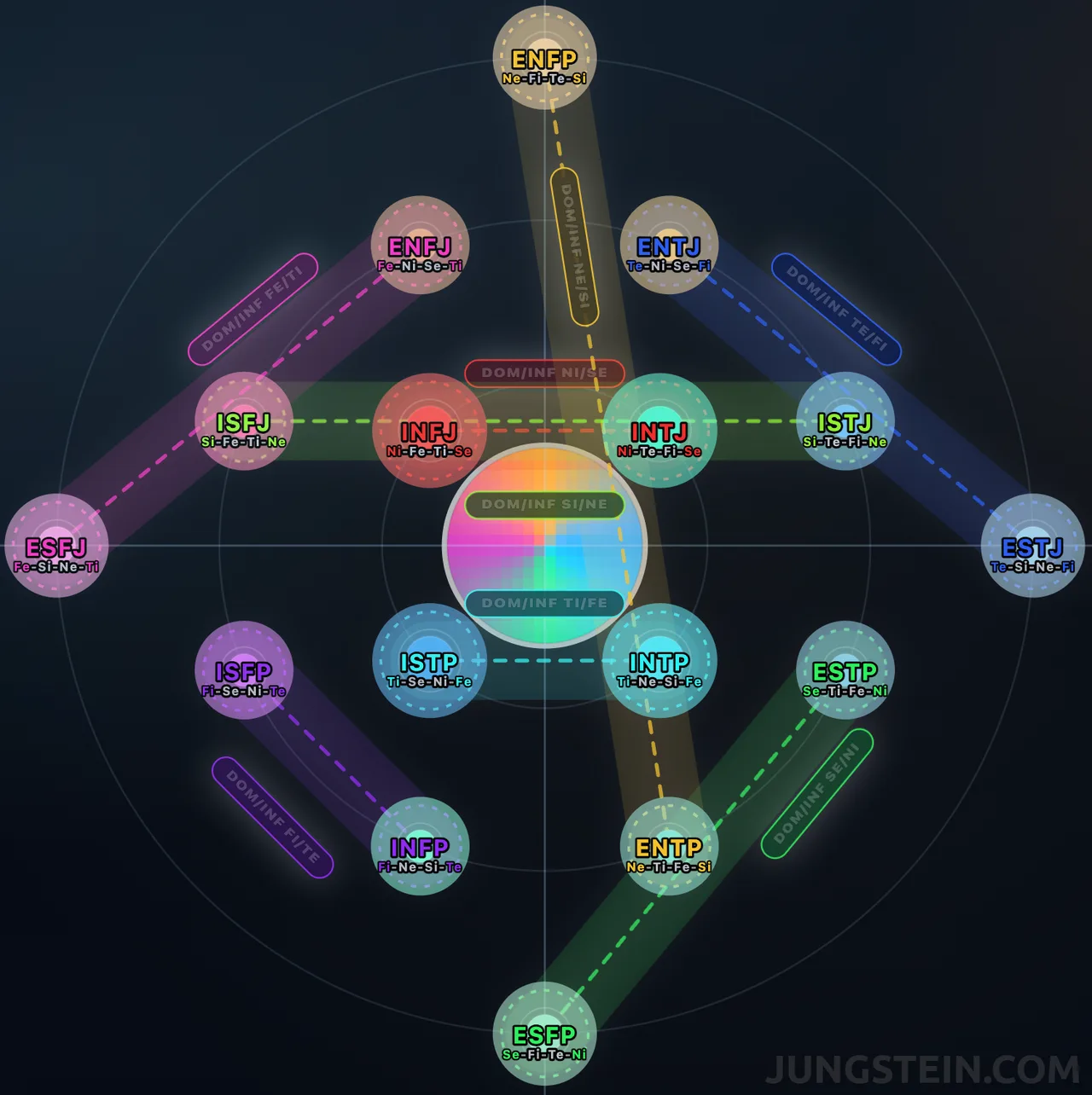
The stack codes were useful, but they also started to feel like a ceiling. A four-function stack is a compact shorthand, not the thing itself. It can point toward a structure, but it can also make you inherit everyone else’s assumptions about what that structure is supposed to mean.
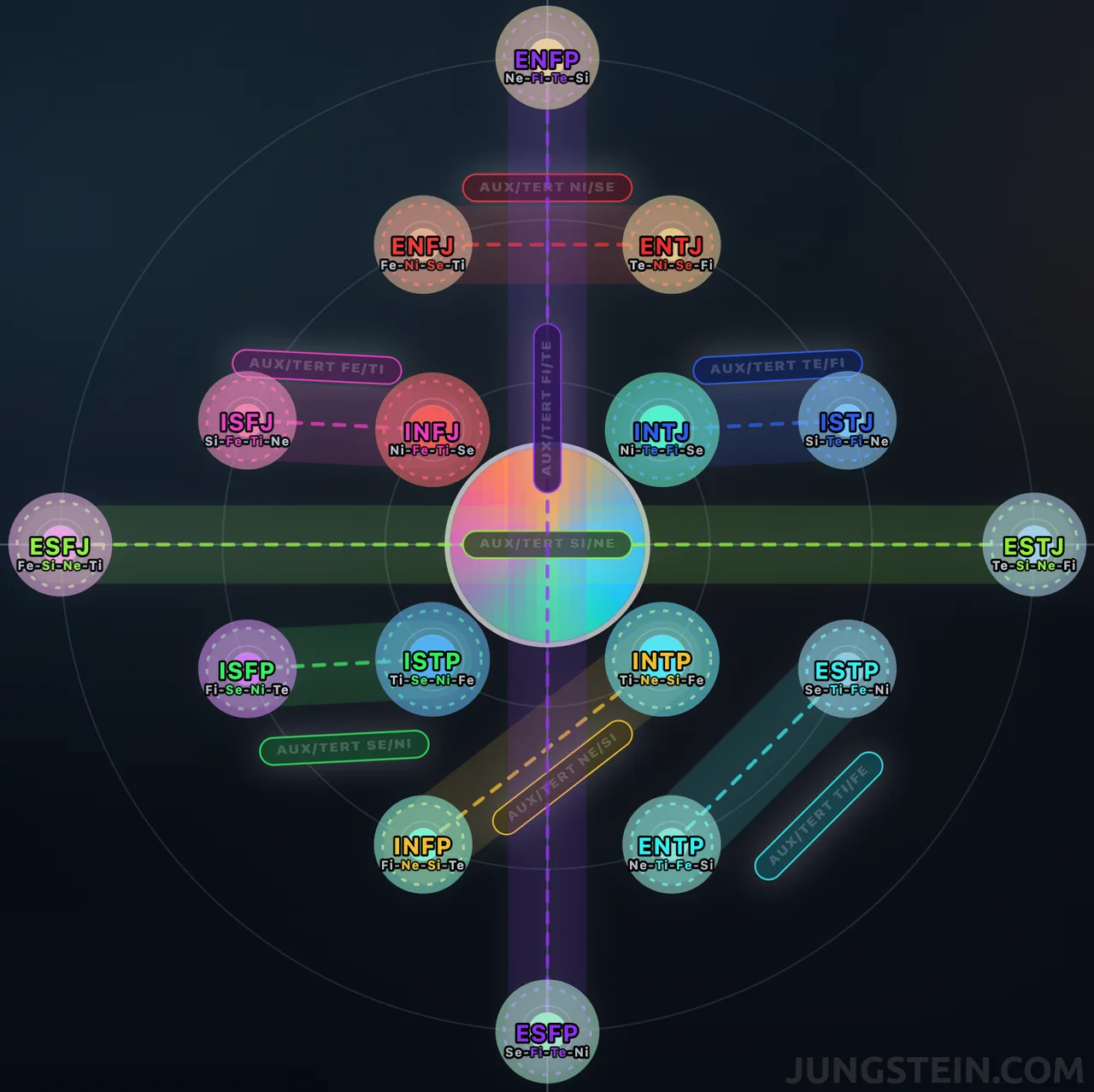
That is where the project changed shape. If I wanted to really understand what was going on, I could not just keep rearranging other people’s interpretations. I had to throw most of them out and rebuild from the bottom up: functions, attitudes, axes, oppositions, neighboring positions, and the strange little symmetries that appear once the field is drawn.
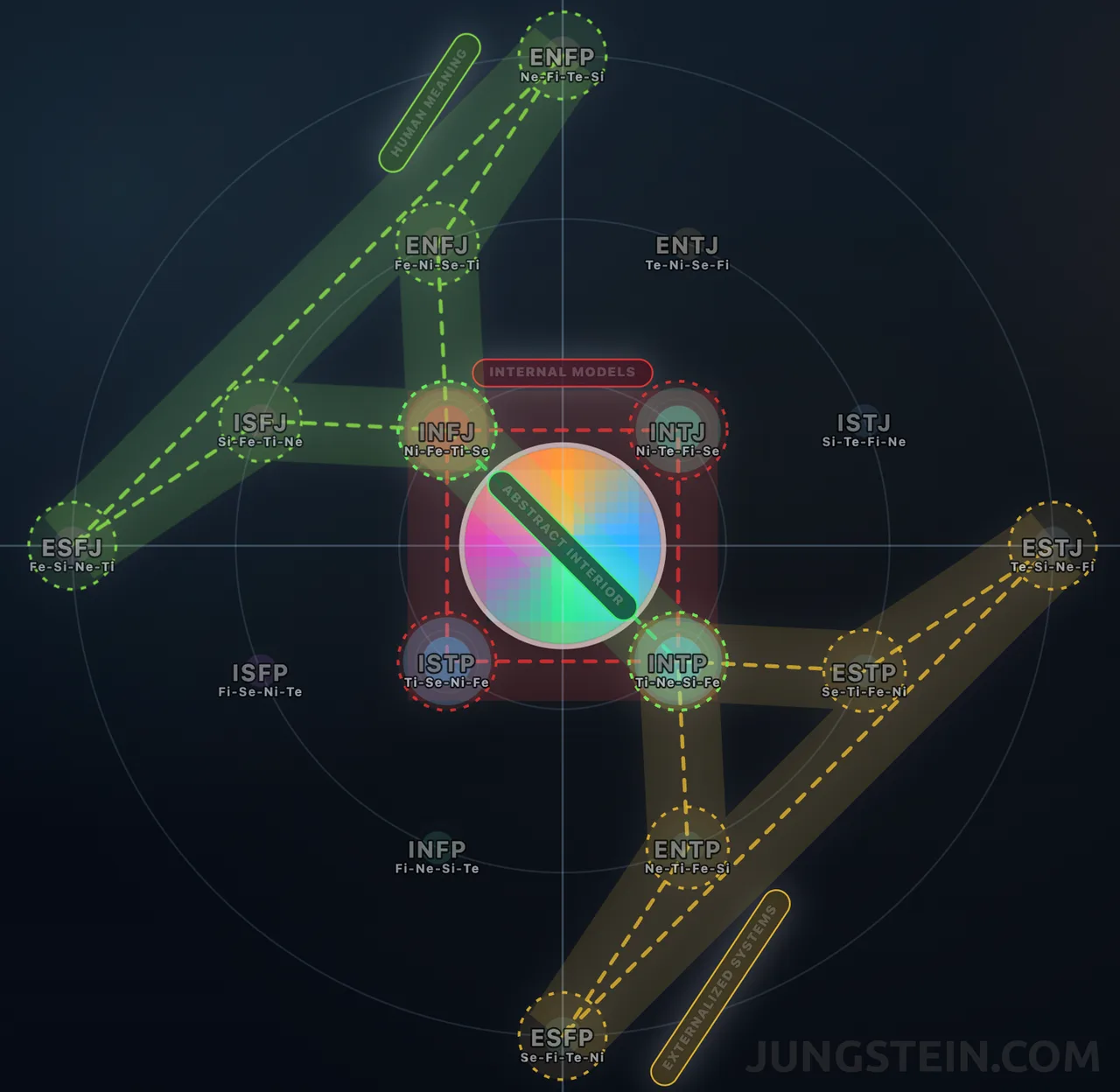
This is, admittedly, a very INTP/INFJ kind of problem. Take a system everyone already has names for, distrust the names, pull the wiring out onto the table, and start asking what the structure is doing before deciding what it means.
If, as seems probable, the aeon of the fishes is ruled by the archetypal motif of the hostile brothers, then the approach of the next Platonic month, namely Aquarius, will constellate the problem of the union of opposites. It will then no longer be possible to write off evil as the mere privation of good; its real existence will have to be recognized. This problem can be solved neither by philosophy, nor by economics, nor by politics, but only by the individual human being, via his experience of the living spirit, whose fire descended upon Joachim, one of many, and, despite all contemporary misunderstandings, was handed onward into the future.
Because the world, without these men knowing it, have entered into the month of that great year where one should only believe what one knows. That is difficult enough, but it is also the remedy for the long sickness that arose from the fact that one believed what one did not know.
The Field Begins To Warp
The map helped. It is a lot better than the usual typology habit of tossing labels into separate boxes and pretending that counts as geometry. But it also exposed a problem. Once the positions were visible, they did not behave as if they were sitting on one calm, evenly spaced plane.
Some regions feel crowded. Others feel strangely far apart. Certain transitions seem shorter than they should be, while other neighboring positions behave as if there is more distance packed between them than the flat chart can explain. The limitation was the flatness of the map.
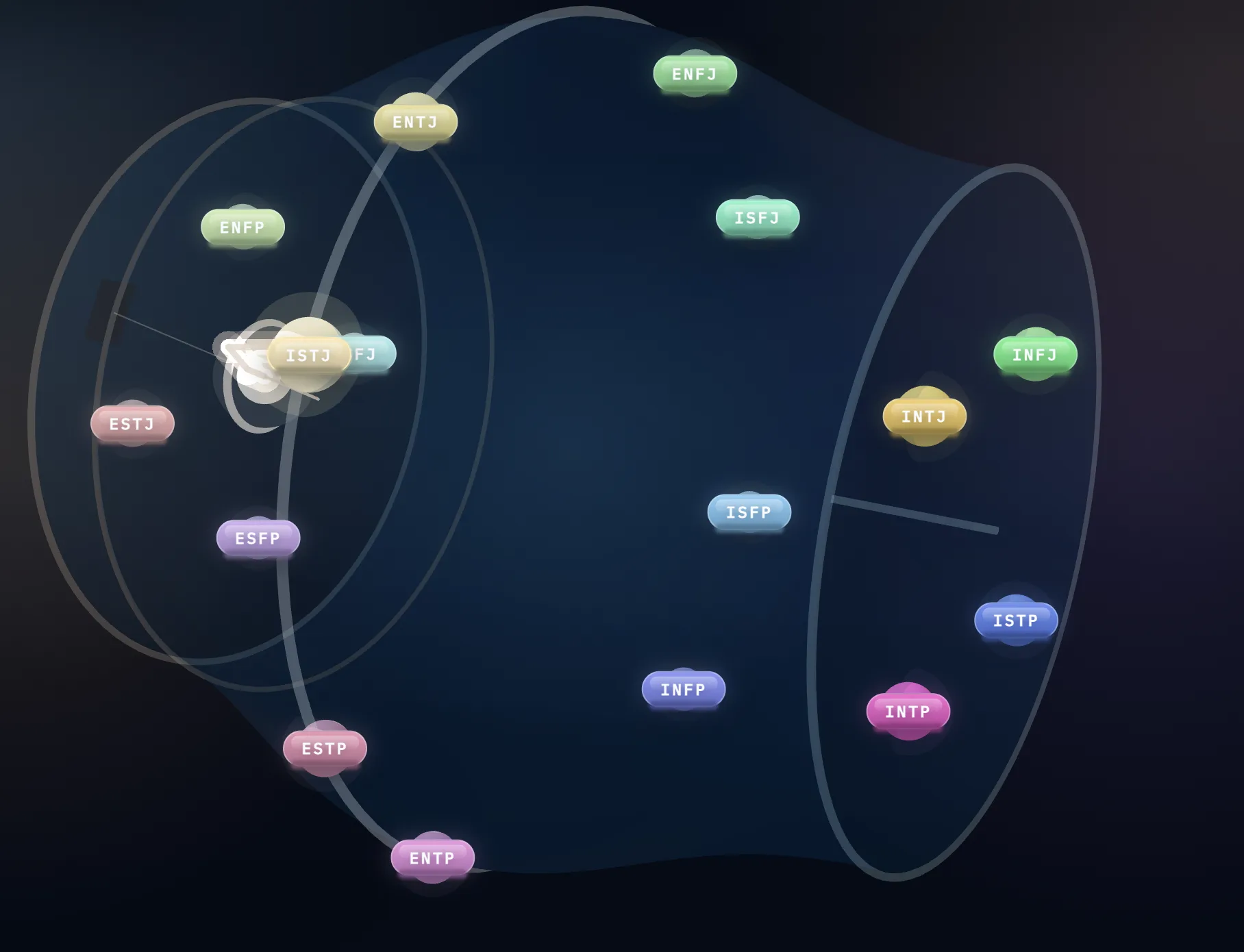
That is the question underneath these later drawings: if psyche presents itself in relativistic terms, how would you explore it in a higher-dimensional space? I do not have a clean answer yet. A flat map is inadequate here.